
The Three Things Every Defence Capability Demonstration Should Capture

Context. Proof. People. Three simple things that can turn footage of technology into a useful story.
A defence capability demonstration can produce some spectacular footage.
Vehicles moving at speed, autonomous systems operating, drones flying, communications equipment being deployed or technology being put through its paces.
But spectacular footage doesn't automatically make useful content.
When we're planning coverage of a capability demonstration, we keep coming back to three things:
Context. Proof. People.
They're simple, but missing any one of them can make the finished story considerably weaker.
1. Context
First, show us where we are and what's happening.
Wide shots are often overlooked because everybody naturally wants to get closer to the technology.

But context gives the audience a sense of environment, scale and purpose.
If it's a vehicle trial, show the terrain.
If it's an integration exercise, establish the different systems involved.
If it's an exhibition, show the environment and audience.
If it's experimentation, capture some of the preparation and activity surrounding the test.
These aren't necessarily the glamorous shots, but they're often the shots that make everything else understandable.
2. Proof
This is where the capability earns its place in the story.
Don't just show the product. Show what it does.
If you're filming a communications system, don't rely solely on beautifully lit shots of the equipment. Capture the system being deployed, operators interacting with it and, where possible, the effect or outcome.
The same applies to vehicles, robotics, sensors and virtually every other defence capability.
Ask:
What would I need to see to understand why this matters?
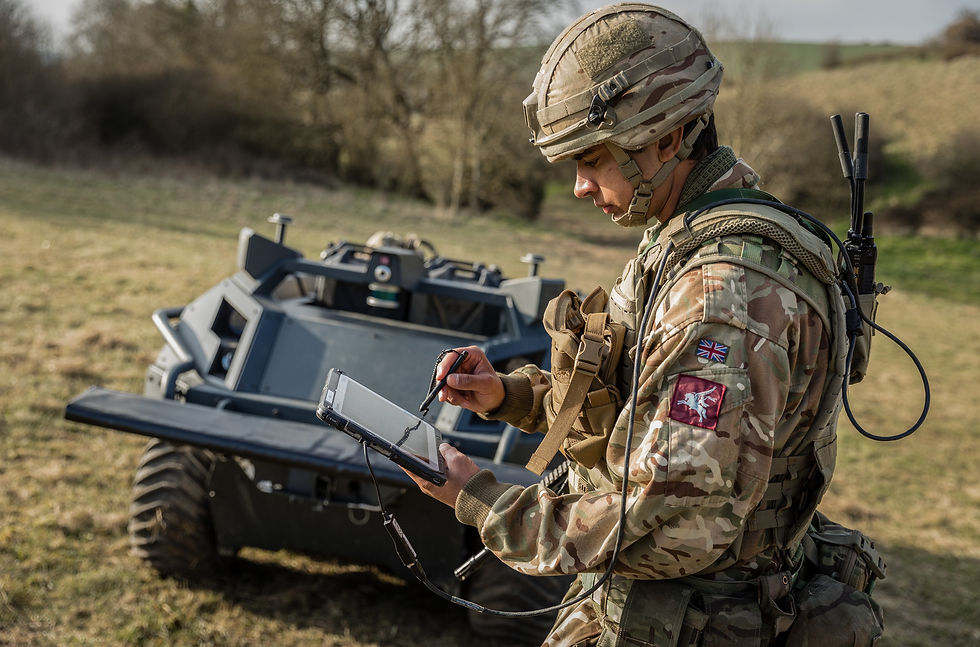
Sometimes the answer isn't particularly cinematic.
That's fine.
Our job isn't simply to make technology look impressive. It's to communicate what the technology actually enables.
3. People
This is the element we see forgotten most often.
Defence technology doesn't exist in isolation.
Somebody designed it. Somebody operates it. Somebody maintains it. Somebody has spent months or years solving the problem behind it.
Capture those people.
That could mean interviews with engineers and programme leads, an operator explaining how something works or simply observing people naturally interacting with the capability.
Human moments also provide scale and authenticity.
A vehicle photographed on its own tells you something.
Put a person beside it and suddenly you understand its size.
Show somebody operating it and you begin to understand how it is actually used.
Let an engineer explain why it exists and you have the beginnings of a story.
You need all three
Imagine a film containing nothing but beautiful close-ups of a piece of equipment.
It might look excellent, but the viewer may finish without understanding where it operates, what it actually does or why they should care.
Context answers:
Where and why?
Proof answers:
What does it do?
People answer:
Who does it matter to?
Bring those together and you're no longer simply documenting equipment.
You're communicating capability.


Comments