
Using Military Actors to Create Authentic Defence Content

When the right people, equipment and environment come together, a product film becomes much more believable.

There are plenty of situations where filming serving military personnel isn't practical.
Timings don't align. Personnel aren't available. The production needs multiple takes. The scenario needs to be carefully controlled. Or the client simply needs greater flexibility than a live military environment allows.
That's where military actors can be extremely useful.
But there's a significant difference between putting somebody in camouflage and creating something that actually feels authentic.
Why use military actors?
Actors give a production control.
A sequence can be rehearsed, repositioned and repeated. Camera positions can change. Lighting can be adjusted. The same action can be captured several times.
For product films in particular, that flexibility allows us to concentrate on clearly demonstrating the capability rather than hoping we've captured an action correctly first time.
They can also make it possible to create scenarios that would otherwise be difficult to organise purely for filming.
Military experience matters
Where possible, we prefer working with people who have genuine military experience.
There are little things that somebody who has served will often do instinctively.
How equipment is carried. How people move together. How someone interacts with a vehicle. How kit is worn. How they communicate.
Individually, these can seem insignificant.
Collectively, they're often the difference between something looking believable and something feeling staged.
And defence audiences notice.
The location matters just as much
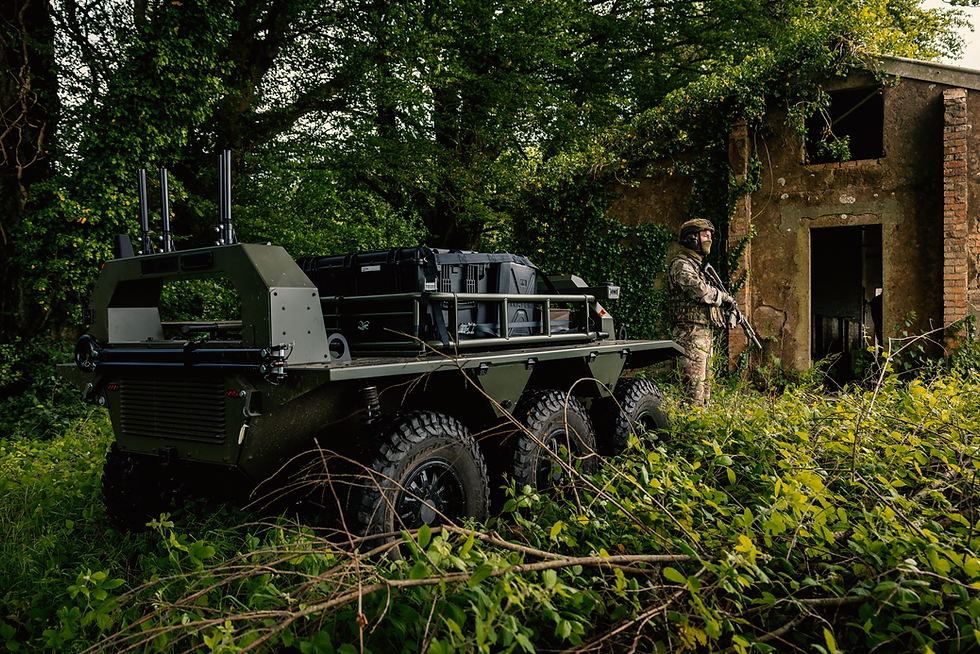
You can have excellent actors and the right equipment and still undermine the whole production with the wrong environment.
A location needs to support the story.
Depending on the capability, that might mean woodland, an urban training environment, open ground, industrial buildings, tracks, quarries or specialist facilities.
Finding locations is therefore part of production planning rather than an afterthought.
You also need to consider vehicle access, permissions, power, facilities, drone restrictions, safety and whether the location actually allows the sequences you've planned.
Don't turn it into Hollywood
Authenticity doesn't necessarily mean explosions, smoke and dozens of people running around with weapons.
Quite often, less is better.
If we're demonstrating a communications system, for example, the story may simply require a small team moving through an environment, deploying the equipment and showing how it supports them.
The technology should remain the hero.
The actors and location provide enough reality around it for the audience to understand how the capability might be used.
Bring everyone into the plan
Productions involving actors, vehicles, specialist locations and several defence companies can become complicated quickly.
That's why pre-production matters.
Before filming, everyone should understand what we're trying to demonstrate, which sequences are required, what equipment needs to be present and who's responsible for each element.
A storyboard and shot list can be particularly useful because technical teams can look at a proposed sequence and say:
"That's not actually how we'd use it."
It's considerably better to have that conversation before the filming day.
Authenticity comes from the details
Military actors aren't about pretending a commercial production is something it isn't.
They're a production tool.
Used properly, they allow defence companies to demonstrate products and capabilities in realistic scenarios while maintaining control over the filming environment.
Combine the right people with an appropriate location, accurate equipment and a production team that understands the defence environment, and you can create something that feels credible without losing the flexibility needed to tell the story properly.
Comments